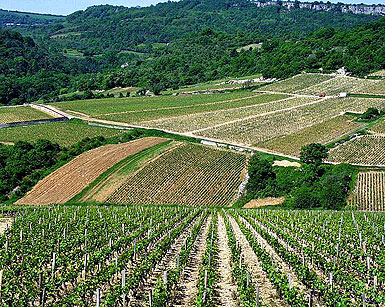
         
Welcome to
Style de Vie
our page about French lifestyles.
It is here that we will present vignettes
gathered from many sources for
your enjoyment. Expatriates living in France have
interesting stories to
tell; part- or full-time residents of Paris give their perspective
on what's new, intriguing or
unexpected in the City of Light; and the many
unique and adventurous
people living their dreams in France will share their
experiences. The lifestyle
of the French native, often the object of envy elsewhere
in the world, of course will
not be overlooked . . . so come along for a glimpse into the
daily life and often fascinating
lifestyles of people in France.
CONTENTS
Cruising Vineyards on the Canal du Midi
A New Life in Limousin ~
eventually!
Café Sitting is a Full-Time Job
The American 'Frog' in Sologne
Edgy Delights in Paris' Twelfth
Two Glimpses into Provençal Village Life:
The
Gentle Pace of Eguilles
Saignon: Built on Rocks and History
Burgundy on a Plate
Cruising
Vineyards on the Canal du Midi
by Marlane O’Neill
Last
year in September we sold our English narrowboat to move to the south of
France and onto a Dutch cruiser suitable for the inland waterways of mainland
Europe. We are Americans, by the way, but love the European canals
and rivers and living aboard. England is charming and quaint, but
we still couldn't resist the allure of France with four times the miles
of inland cruising and . . . oo-la-la . . .much, much more.
So,
we found ourselves in southwest France near sunny Montpellier, creating
a new floating nest on a 42 foot Palma de Groot motor boat. She has
two bedrooms and toilettes and a complete kitchen along with a barbecue
on the stern. The marina in which she was located is a small tourist
town called Ariane de Latte and very quiet -- in fact practically
deserted in the wintertime.
We
opted instead to cruise the Canal du Midi and winter over in the
city of Toulouse, also known as La Ville Rose, so named since buildings
and sidewalks are made of bricks ranging in color from yellow to pink,
giving a rosy glow. [Ed.
The region is one of two in France without suitable local stone for building,
thus the use of Roman style brick.]
The Canal
du Midi is one of three canals that join to connect the Mediterranean
Sea and the Bay of Biscay in the Atlantic -- they are collectively known
as the Canal Entre Deux Mers - the canal between two seas.
The Canal du Midi runs for 240 kilometers (about a hundred and sixty
miles) from Etang de Thau to Toulouse and has over 100 locks able to contain
vessels of 30 meters long. It was the conception of a wealthy entrepreneur,
Pierre-Paul Riquet who, after its fourteen arduous years of creation, died
bankrupt a year before it was completed in 1681. The numerous statues,
plaques and memorials along the canal are testament to him and the power
of his dream.
October
found
us waving a dawn farewell to the friendly boaters in Port Ariane de Latte
as we cruised to the medieval city of Agde. In Agde the famous large
round lock gives boaters the choice of entering the Herault River, which
leads to the Mediterranean or onto the Canal du Midi, straight ahead.
We choose door number two, and as the lock opened splendid tall broad
leaf trees methodically planted in neat rows on each side of the water
greet one as if to say ‘welcome’. They are a hallmark of the Midi
and cover much of the distance, giving needed shade and holding in the
bank walls thus preventing erosion.
This
was harvest time or the vendange in France, the season when the
next vintage’s grapes are picked and pressed. The smell of crushed
grapes was everywhere and hand written signs said, ‘Warning – Harvest
in Progress’, since small golf cart sized trucks are exiting the
vineyards in a fury laden with their rich bursting produce hurrying to
disgorge the purple fruit and go back for more. One gentleman simply
drove to the window of a beautiful old chateau where he hauled a hose through
to vacuum the grapes straight to the pressoir. He nonchalantly
drove the fruit with a foot pump and enjoyed a smoke at the same time.
He didn't mind at all when we requested a photo. Vineyards are everywhere,
on both banks of the canal, and stretch for miles to the horizon.
Romantic chateaus sit proudly on their green and purple fields, the result
of a year’s hard labor and precious investment. So much is dependent
upon the weather, the sun and the rain -- the ingredients that will give
this year its distinct qualities from the last and the next. Their
world to be had in a bottle of aromatic liquid.
These
vines date back thousands of years and several villages claim to have the
very first planted by the Romans. Who can truly lay claim to being
the ‘first’ is not clear. But, it is evident that many wines
along the Midi are becoming known due to their fruity and round flavors
that are now the rage in California and Chilean wines. Lucky for
us, they are not so trendy as to drive up the prices. Experimentation is
painless since a bottle that is not quite up to par can end up in coq
au vin or boeuf bourgignon, two delicious dishes of chicken
and beef, respectively, made with a large quantity of wine. Happily,
not much was given up to la cuisine; most of it ended up in the
cook and guests!
Winter
in Toulouse brought a grand Salon des Vins where the local vintners
around the Midi showcased their product. It was a good thing it lasted
for a few days since it took that much time to properly taste and select
wine to take home. Most of the time the real producers were on hand
to discuss their wine – they are the ones with callouses and deep suntans;
their name tags matched the name on the bottle. The people in nice
suits with good manicures were the hired hands!
With
the arrival of spring we cruised from Toulouse to Bordeaux stopping along
the Canal Latéral à la Garonne to visit vineyards
or attend tastings. The village of Buzet, just a few miles from Bordeaux,
was memorable for its large impressive cooperative with several competing
Buzets available. There we met two Belgian wine merchants having
a lively time buying a huge quantity to bring back to Brussels. They
explained that the high price of Bordeaux wines had brought them to seek
out the lesser-known wines nearby.
Bordeaux
is remarkable for the comparative lack of good priced inventory and middling
quality. So much of the wine is exported that little of real value
is left for the locals. We turned around from Bordeaux, heading for the
Rhône River and Paris.
How
do you make sense of the dozens, maybe hundreds of labels to choose from,
especially when the cost of the bottle has little to do with the quality?
Cost is really a consequence of popularity, not excellence, one of our
hard-won lessons. In fact, Rob compiled the following list, which
he calls “Marlane’s Wine Rules”, so we both claim the blame if anyone
disagrees. Here it is:
Marlane’s
Wine Rules by Rob
1. Start
by looking at the bottle, not the label. It should be weighty with
a dimple in the bottom. The heavier the bottle, the deeper the dimple,
the better.
2. It
should say Mis en bouteille a la propriété or Mis
en bouteille au château’, meaning that it was bottled at the
vineyard not at a factory far away. In these cases then it would
say Mis en bouteille par… meaning by another company other than
the vintner.
3. A
vintage of about 2 years is recommended, but not much more unless it is
from Gaillac or Buzet villages where the wines are known to be best around
5 years of age.
4. The
phrase Appellation… Contrôlée should be visible.
In between these words will be the region the wine is from, thus a wine
from the town of Minervois, for example, will say Appellation Minervois
Contrôlée or if from Bordeaux it will say Appellation
Bordeaux Contrôlée and so on. It could also
say Appellation Origin Contrôlée which is okay as well.
These are the governing boards that ensure a standard of production is
met so that the wines retain their quality. They examine production
from beginning to end and guarantee no funny business went on in its creation
as well as controlling the percentages of different grapes that go into
the blend.
5. Medals
are good. A bronze, silver or gold sticker saying Concours des
Grands Vins de France, Macon, Medaille d’Or, 2002 says that the wine
was given a gold medal in a large wine contest in Macon in 2002.
This wine contest is one of the biggest and thus these medals are very
valuable. However, be on the lookout for shiny metallic stickers
that are not medals, but look-alikes, fooling a casual buyer. They
will say things like ‘harvested by hand’, which is not a blue ribbon.
6. Many
vineyards number their bottles. It’s a mark of extra care and interest,
and a bottle with a number gets a plus sign from us. Not all are
great, but some of the best have had numbers.
7. This
is a personal preference. While all the above rules apply to any
wine from any region of France, if it is a wine from the Canal du Midi
then we are most likely to give it a thumbs up over other areas such as
Burgundy, Bordeaux or the Alsace. These fruity, rich and heady wines
are similar to the best Californians that are very popular all over
the world. But, beware, there is no Appellation Canal du Midi
Contrôlée. One has to be familiar with the names
of the villages producing wine. There are many, but a few of
the outstanding that come to mind are: Minervois, Corbières, Cahors,
Gaillac and Buzet.
While
getting to know the wines along the Midi, we found one more rule of thumb
that is the last but not the least:
8. You
don't need to pay more than about 5 or 6 euros for a good bottle, and often
will pay much less; there are excellent wines that meet all the above rules
for as low as 3 euros. Unfortunately they often sell out before we
can stock up!
The
last rule was actually hard to follow, believe it or not. For folks
used to paying at least 10 dollars for a ‘decent’ bottle of wine in the
USA, it's scary to plunk down 3 euros and not be convinced that this wine
is for the chicken at best. Life is too short to drink bad wine,
but it doesn't have to correlate to ‘you get what you pay for’. For
now, at least, you are getting a whole lot more than what you pay for,
and that's a nice rule to break!
Whilethese
are the general guidelines, all rules are made to be broken and amazingly
good wines exist that don’t fit all the criteria. In fact, there
is an outstanding Corbières only sold as ‘bag in the box’,
and it puts many good bottled wines to the test.
The
beauty of the wine country along the Canal du Midi is an unexpected
surprise and an excellent primer for discovering wines elsewhere in France.
A
votre santé!
Marlane
O'Neill was born in New York City. A former art importer and holding
degrees in English and Fine Arts, it was while working at the
Greater
Miami Opera Company that she met Rob O'Neill. Rob, from St. Louis, graduated
with a degree in Fine Arts from Columbia
University,
Missouri, going on to work in television production in St. Louis and Miami.
When they met they found that one of their many
common
interests was boating. Together they live on the waterways of Europe
onboard OO-LA-LA, a Dutch motorboat.
Marlane's
book, "Living the Dream on the Canals of England", is
an anecdotal account of their year
spent traveling
English inland waterways on a narrowboat and is available now on www.publishamerica.com.
To follow
their ongoing story on the waterways of mainland Europe visit http://www.robandmarlane.com
[Photos and
map used in this article are the copyrighted property of Marlane and Rob
O'Neill]
A New Life
in Limousin ~
eventually!
by Julie Thirkettle
Life
in Yorkshire was not going well for my family and me. After 2½ years
of battling, my husband of over 20 years lost his life to cancer.
Also, one of my daughters had a further blow when her partner abandoned
her and their 3 month-old baby.
My
husband had had a good career as a university lecturer, and I had stayed
at home to bring up our four children. I found myself not only without
my husband, but also without any qualifications and, therefore, no income.
My daughter needed to work full time to support her son but did not want
to be apart from him. At crisis point, we realized a huge change
was required. We work well together and decided to put my house on the
market and look for a larger property where we could run a bed and breakfast,
thus solving our employment problems.
As
UK house prices are so high, we could not afford a property suitable for
a large bed and breakfast, so we looked further afield and settled on the
Limousin of central France. The Limousin was an ideal area because
it is rural (very important to us as we have lived in rural Yorkshire for
over fifteen years), houses were good value for the money, and it would
be accessible for my son (who is at university in England) and my other
two daughters.
After
a couple of house hunting trips, we found a renovation project near Eymoutiers
in département 87, the Haute-Vienne. When completed we would
have a gîte complex and a large barn conversion, housing both our
living quarters and a bed and breakfast. As our house sale in the
UK had completed, we signed the Compromis, packed up our Nissan Micra (containing
3 dogs, a baby, two adults and some belongings!) and made the journey to
France. We were to live in rented accommodations until the purchase
was completed.
Two
weeks before the completion date, the purchase started to fall apart.
Numerous problems occurred, including tax and land issues, and after four
months of heartache the sale eventually collapsed when the CU for the barn
conversion was refused.
Wewere
house hunting once more, property prices had risen, and as we had been
living on the proceeds from my house sale for over seven months, my capital
had shrunk. We had to change our criteria and look at any property
from which we could start a business without major renovation work.
Luckily,
we found the perfect property in the medieval château town of Bourganeuf
in the département of the Creuse, again in the Limousin.
It belonged to the local Notaire and was in good condition ~ we just needed
to add some bathrooms and redecorate. Following the viewing, we rushed
to the estate agency and signed the Compromis.
As
we had sold our furniture in the UK, we needed to furnish this 8-bedroom
house. We could not afford antiques but needed classic furniture.
After reading about brocantes and trocs, we started our search
by visiting local outlets. Unfortunately, we were very disappointed; although
the style was right, the furniture was often scratched or damaged, chairs
needed reupholstering, and every piece had one thing in common ~ woodworm.
Another problem was that we needed a large amount of furniture and did
not have the time to trail around shops each week in the hope that they
might have had some new deliveries.

SLEIGH BED
AND CLASSIC FRENCH CHAIR FROM LE VERGER HANDMADE FURNITURE
After
ruling out brocantes and trocs, we decided to look at the
new furniture market. Again we were sorely disappointed. The good
quality furniture was very expensive and the inferior quality was overpriced.
After complaining about our problems to friends, we discovered that they
too had had similar experiences. We realised that there was a hole
in the market, so, after hours of research and visits to numerous suppliers,
we decided to set up Le Verger
Handmade Furniture, offering high quality furniture in classic
designs. Now open, we will run this company alongside our bed and
breakfast which is due to open in March 2006 when all of the new bathrooms
will be completed.
My
family and I are enjoying life in Bourganeuf. We are settling in,
and I am very excited about what 2006 will offer.
Julie Thirkettle
- SARL Le Verger, 4, allée du Verger, 23400 Bourganeuf, France.
SIRET: 484 538 376 00019
Telephone:
00 33 (0)5 55 54 99 08. Email : info@leverger-france.com.
Website : www.leverger-france.com
Photos available
on request.
Café
Sitting is a Full-Time Job
by Jill Butler
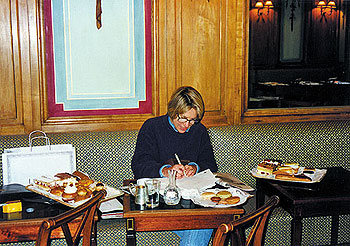
I started
everyday in the corner café, not just any café,
but rather the famous Salon du Thé, Ladurée, on the
rue Royale, numéro 16.*
First
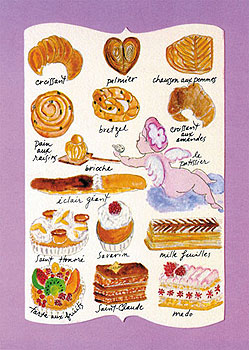
priority was un double express et un croissant aux amandes. Next
came the reading of the newspaper, not just one, but three: the International
Herald Tribune, The International Edition of the Wall Street Journal, and
Le Figaro. For survival at a dinner party or social conversation,
it is imperative to be on top of the news both in France and in the US.
I had a lot to learn.
Having
moved from New York City, I'd taken up the habit of eating breakfast out.
It seemed the perfect way to connect with the still somewhat sleepy world,
to see people, to be alone, but not lonely. I could ease into my work as
the caffeine did its job.
I
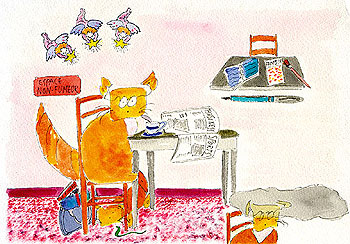
wrote my first book, Paintbrush in Paris, sitting in Ladurée.
I went daily for nearly 14 years. Paintbrush was my American cat that immigrated
with me. He was my English-speaking friend and voice in telling our story
of moving to Paris through this first illustrated book.
The
day came, a year and half later, when the first copies of Paintbrush
in Paris arrived. I held my breath and slowly let it out as I read
it through. It wasn't embarrassing!
The
next morning, I tucked a copy into my bag and headed out for breakfast.
I shared it with Anick, my usual serveuse, and she shared it with
the manager, Monique.
By
a convergence of the stars, the new owners of Ladurée, Francis Holder,
and his son, David, were sitting next to me at one of those miniature tables
~ meaning we were practically sitting elbow to elbow. So, Paintbrush
in Paris was again shared by Monique, but this time with the Holders.
Mr.Holder Senior ** turned to me and said, “Charmant, Madame, bravo!”
He asked me who I was, what I was doing in Paris and suggested I should
illustrate something for the salon.
Heart
pounding, I spontaneously proposed a series of postcards that could be
sold to other Ladurée and postcard enthusiasts like myself. He took
to the idea and immediately passed me and the idea to his son, David, with
whom I negotiated our agreement. I was then introduced to their design
and interiors director. With the details of our project concluded, it was
time to begin.
I
love to draw food but this felt like an exam. Being a self-taught artist,
I hoped I would pass the test. On Monday morning, I was "installed" upstairs
in the newly renovated, smoke-free dining room and for three intense mornings
silver trays filled with “samples” of every patisserie, Viennoisserie,
et dessert was placed before me ~ to draw!
After
making preliminary sketches, I choose to work with two illustrative styles:
one a cut paper style (the façade and coffees ) and the second a
more classic pen and ink watercolor style (the map, macaroons, Viennoisseries
and pastries) as well as a mix of both (the salon interior). Things like
capturing the whipped cream or the layers of a mille feuilles were
tricky as were les macarons, Ladurée’s signature product.
The
cherubs painted on the ceiling of the ground floor room alone are worth
the visit. If you look closely you can see they are baking the bread by
the rays of the sun. I choose to use the cherubs throughout the series
of six cards. They also appear in the Ladurée logo.
Eventually,
every drawing was checked by the design director for accuracy and the text
was bien regardé for spelling errors and inaccuracies. The
last look was with David and the printer, and off to press it went.
I
smiled when I saw customers discovering the cards as they paid à
la caisse. The enthusiastic mid-westerner that I am wanted to jump
up and introduce myself ~ but I contained myself with being happy that
they were being purchased.
For
sure now, I knew that café sitting was ~ if not a full-time
job ~ it was a job!
ONE OF
JILL BUTLER'S POSTCARDS (SMALLER THAN ACTUAL SIZE)
As
a final note, what I learned was to go ahead and speak up in my less than
perfect French, to enjoy the moment, to be slightly outrageous by French
standards and to go ahead and put forth an idea when given the opportunity
because who knows who's sitting next to you waiting to respond in the positive?
Jill Butler
tells us, "At age five I had a dream. I was standing on the Left Bank looking
across the Seine to the backside of
Notre Dame Cathedral. Years later, I found my myself living next to Notre
Dame on the rue du Clôitre. Notre Dame and the bells
awakened me daily. Fourteen years of living in Paris and Normandy
have given me an abundance of experience and design
inspiration for The Jill Butler Collection of travel guides, dinnerware
and tabletop accessories."
You can
reach Jill by email at jillbutler@jillbutler.com or visit her lively web
site at http://www.jillbutler.com.
[Photos &
illustrations ©2006 by Jill Butler]
The American
'Frog' in Sologne
by Kristi Anderson
I
first fell in love with France in the late 70s when I went work as a model
in Paris. But, being slightly too short to make the « big bucks
», I returned to New York and found a very nice career for myself
in advertising.
However,
I remained in love with France, and in the fall of 1988 I arrived in Paris
to, you guessed it, marry a Frenchman. At the age of 36 not only didn't
I know one word of French, but I barely knew how to use a microwave!
Six months of Alliance Française and a few cookbooks later,
I felt I was well on my way.
In
1990 I opened Tea and Tattered Pages, a used English bookstore and
tearoom which, in spite of its small size, became internationally known
for the reasonably priced books and the charm and ambiance of a bookstore
offering the first of what became the fashionable combination of serving
« comfort food » and tea in a bookstore. Borders and
the rest came after! My press book attests to the store's success with
appearances on Telematin, Paris Premiere, and Jimmy. Articles about
Tea
and Tattered Pages appeared as far away as Iceland!
In
1998, my husband and I divorced and, having stayed in love with France,
I sold my Parisian bookstore and bought a delapidated auberge in
the tiny but charming Solognot village of Ligny le Ribault.
After
five long years to completely renovate Auberge Saint Jacques, it
has become une maison d’hôtes where themed weekends focusing
on falconry, cooking, or biking are becoming well known. But, all
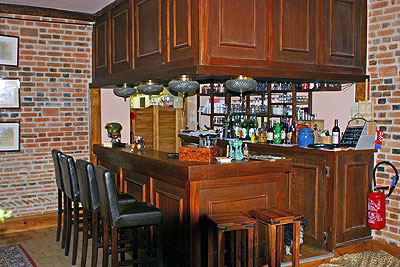
that was not enough for me. I have turned the orignal bar into what
can be compared to as an English club and named it Le Coin Perdu.
I have found various artists to exhibit their works there, and one never
knows what one will find: watercolors of a sublime Sologne, charatictures
of European soldiers, or modern oil paintings. Each exposition changes
the ambiance of the « club ».
A new
addition to the Auberge Saint Jacques are themed dinners once a
month. Past dinners have included Thanksgiving, Russian New Year
and Saint Valentines. Each menu and history is well reseached so
that when a guest leaves, he or she is not only extremely well fed but
more informed as well! My cooking classes are also just as diverse
~ Indian, Chinese, Tex-mex, as well as foie gras, and even a "gôuter
en anglais" for children from 7-12.
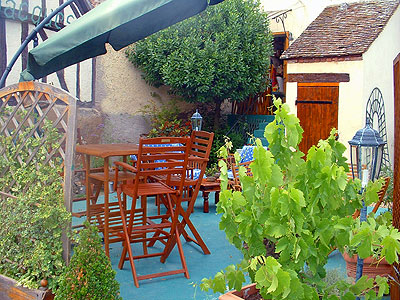
It
is well worth a weekend trip to enjoy the beautiful sights of Sologne,
and I promise to welcome you with warmth and good humor to my little village
and Auberge Saint-Jacques!
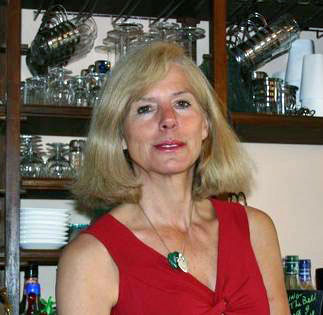
Kristi Anderson,
proprietor of l'Auberge Saint Jacques, has established herself
in the small
village
of Ligny le Ribault just south of the Loiret département capital
of Orléans.
Her theme
weekends, cozy guest rooms and dynamic art exhibits will entice you to
stay!
For details
visit her web site at http://theamericanfrog.com
or to contact
her, send an email to kristi.anderson@orange.fr.
Auberge
Saint-Jacques is located at 15, place de l'église - 45240 Ligny
le Ribault - Tél : 06 83 18 42 31
Edgy
Delights
by Helen Vaughan Simpson
Think
about it. Most of us who have been to Paris more than once or twice
are past the Eiffel Tower-Notre Dame-Louvre tourist circuit. Not
that I don’t relish one more trip to the Louvre and the Musée
d’ Orsay each time I go, but, in my passion for Paris,
after the first few visits I wanted to know more about this beguiling city.
That
hunger drove me beyond the city center and the tourist tracks that Fodor’s
and Rick Steves have ensured are familiar and fully known. What
dedicated Francophile isn’t already familiar with the rue Cler in the 7th
arrondissement, or the rue Mouffetard in the 5th? I wanted
something more, something different. In looking for that something
different, I found the edges of Paris and the edgy delights
she yields up only to those who seek to know her in all her depths.
Paris’
eastern edge draws far fewer visitors than the more celebrated west.
It was years of visiting the city before I ventured into exploring the
formerly artisan and working class 12th arrondissement -- the very
heart of radical and revolutionary Paris. This seldom-explored district
offers a great deal beyond the now popular and trendy Bastille area.
You have to push eastwards, even past the périphérique,
to the very edge of the Bois de Vincennes to find one of the city's
fascinating corners and the Palais de Porte d’Orée.
The
former Museum of African and Oceanic Arts, this extraordinary building
is now the official headquarters of France’s architectural patrimony and
in its own design a unique architectural treasure. It was built to
celebrate France’s pride in her colonies -- it proclaims in a post-colonial
world -- and now, in an embarrassing sort of way, France’s civilizing
imperial mission. Erected in 1931 for the World’s Fair, it
shouts France’s pride in her colonies and her success in shouldering the
white man’s burden. Politics aside, the medium’s message here should
not keep anyone from admiring an art-deco artistic masterpiece.
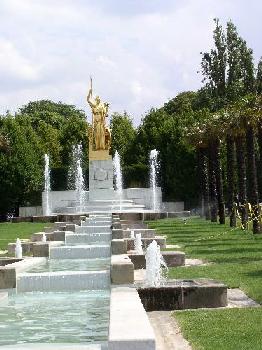
Walking
from the Porte d'Orée métro exit, the visitor approaches
the building past a towering golden figure of Civilizing Marianne, her
image glittering in the reflecting pool, lined with palm trees, stretching
at her feet. The palms are the first note of a colonial song that
rings more loudly as the building, covered with monumental carvings, rises
into view.
The
square columns surrounding the square building pull the visitor around
complex images of ships, tropical trees and flowers, native populations
in exotic dress, elephants and other fauna alien to France but not to her
colonies amid a roll call of the names of the colonies.
Along
the western side, shadowed at times by the filtered light of the trees,
is a list of the names of the architects of France’s empire.
Colbert is there, de Lesseps is there — even Iberville and Bienville,
the “organizers of Louisiana.” All of France’s colonies are
there, even the least important.
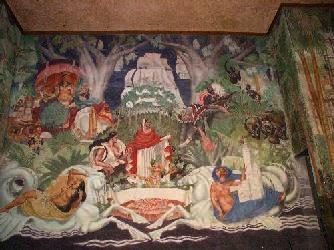
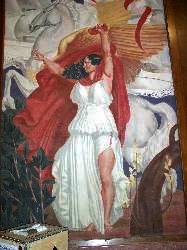
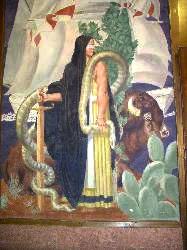
Inside,
in the vast central hall, colorful frescoes in the style of the muralists
of the 1930s continue the celebratory song. The room is beautiful
and the frescoes do as they were intended to do — inspire awe. A
towering figure of blind Justice, French justice clearly, stands in Michaelangelo-esque
majesty in one niche, while above the entrance door a flotilla of sailing
ships carries French benefits to all the corners of the world.
To
complete the introduction to the wonders that colonial exploration brought
to the homeland, the basement aquarium shelters the only alligators to
be found in the city along with illuminated windows of colorful tropical
fish that glow eerily in the darkened corridors. Not far away, near
the Paris zoo and the Lac Daumesnil, is the Buddhist temple.
This
trip to the edge of the city is a visit beyond the borders of France --
even beyond the borders of the Francophone world. Marianne,
holding high her torch of civilization and light, lingers in the mind’s
eye. To know Paris in all the facets of her richness, a visit
to the Palais de Porte D’Orée is de rigueur.
It is more than a visit to a monument — it is a visit to the edges of the
French experience, to the world and mind of the early twentieth century,
to the iconography of the 1930s, to a time when western culture was seen
to shine like Marianne’s torch. And it will introduce you to
the fascinating edges of a city in a constant process of self-transformation.
So don’t stay in the center — go to the edge.
Helen Vaughan
Simpson, a director of Paris Dream Tours, has worked and lived
part-time in Paris
since the
mid-1980s. She is passionate about Paris’ history, artistic heritage, and
past personalities.
For details
about Paris Dream Tours visit the web site at http://www.parisdreamtours.com
or to contact
her, send an email to info@parisdreamtours.com
[Photos used
in this article are the copyrighted property of Helen Vaughan Simpson]

Two
glimpses into Provençal village life
The Gentle Pace of Eguilles
by Barbara Beaumont
Not
long after I returned from a recent trip to Southern California,
I was in my car on the road into my small village when suddenly traffic
came to a grinding halt. I couldn’t see past the long line of stranded
cars to find the reason, but I vaguely remembered some roadwork had been
going on when I left. Five minutes went by, then ten, and finally
I got out of my car to see what the problem was since things still weren’t
moving. Then I saw the real reason: not roadwork but…SHEEP.
A local shepherd was leading his flock right up the middle of the road,
seemingly oblivious to the motorists. Best of all, there were few
motorists who blew their horns or indicated their displeasure. Eventually,
he turned off to cross a field, and we all moved on. Somehow
I couldn’t quite see this happening in Los Angeles.
There
are other advantages to living in a village, and one of my favorites is
the
annual
town “fête”, or party. These always take place near the end
of summer when most people are back from vacation, but the kids are
still out of school. It’s always the “saint’s day” for each town,
and miraculously they all seem to fall in August. Daytime activities
include horseback rides, carousels for small children, “boules” contests
for the men, a band for dancing in the town square at least on one occasion,
and always some large, communal meal for the whole town. Since I
live about 50 yards from the town hall (the center of activities) in my
village, I can’t help but be involved. And, on Bastille Day
the fireworks from the Mairie fall right on my terrace – a free spectacle!
I
find the friendliness of the local merchants, several of whom have learned
my name, to be a real plus. My mailman, who is a neighbor, has become
a valued friend. Visits to the twice-weekly market are always a social
occasion, and most everything I need to find in town can be done
on foot. The passing hours of each day are marked by the bells from
the church that’s just next to the town hall, and I’ve learned to recognize
the different bells that announce a wedding, a funeral or Mass. Somehow
it never occurred to me that all these little things could be so important…..
Barbara
Beaumont, formerly an interior designer in the United States, has been
a
resident
of a village near Aix-en-Provence for a decade. She is also an occasional
contributor to our newsletter.
Her company,
Jaunts in Provence, provides travelers with assistance for their do-it-yourself
holidays
by creating customized itineraries based on travelers' budgets and interests.
You can
reach her at bbeguilles@wanadoo.fr.
[Photos courtesy
of www.mairie.eguilles.fr. All rights reserved.]
Saignon:
Built on Rocks and History
by Marcia Mitchell
Looming
in the distance it looks like a medieval fortress standing watch over the
valley. Up close you can see that it’s actually a cluster of huge
rocks, formed by time in layers of limestone. But, along the rim
of the flat top, you can see sections of a wall of hand-hewn stone.
It is what’s left of the defense wall for the three châteaux that
once stood side-by-side on top of that mammoth rocky outcrop.
Yes,
three
castles!
This
is Saignon, one of the perched villages of the Luberon region of Provence.
It doesn’t boast the fame (or the tourists) of a Gordes or a Roussillon,
but it has the distinction of having once been rich, or important, or crazy
enough to have had three châteaux at one time, back in the Middle
Ages when the average per village was just one, and noble neighbors never
got along.
I read
in a guidebook that Saignon is one of the “as yet undiscovered villages
of the Luberon.” That must be wrong, because I am an American, and
even I know about it. In fact, I left everything behind in Washington
DC and moved to this rock fortress. It looked safer.
My
house is in the Place de l'Horloge ~ the clock tower place.
Believe me, living next to the clock tower makes you acutely aware of time’s
passage (even when you’re no longer billing by the hour). A thousand
years ago, longer than I can remember, our building was part of the ramparts
of the village. Along the west wall runs a chemin de ronde,
where soldiers kept a lookout for invaders. In one corner, you can
see the exposed stone base of the ancient signal tower. Saignon,
it seems, derived from the Roman word signum, for signal.
The giant rocky promontory above our village was apparently the message
center for this part of Provincia Romana.
That
rocky promontory is like a balcony attached to the Plateau des Claparedes
on the northern face of the Grand Luberon. To prehistoric people, tired
of their dark, damp caves in the Aiguebrun valley, it must have looked
like a great place to live, because it soon became an oppidum, or fortified
refuge. Then in 976, documents show Saignon as a castellum,
with a castle and tower of wood, given by the bishop of Apt to brothers
Robert and Varacon.
That's
where the Saignonnais took a characteristic turn off the straight and narrow
one-castle-per-village path. By the beginning of the 12th century,
the tiny village had not one, not two, but three castles standing elbow-to-elbow
on the rock ~ Château de la Roche, Château de Crugière,
and squeezed in between them, Château de Tortamolle, or Méjean
(middle).
We
can only imagine the feudal turf wars.
I
do know one example. As the 14th century dawned, one Bertrand Rambaud de
Simiane ~“Rambo”, I call him ~ was lord of the runty middle castle.
Next door, within spitting distance, was the gigantic castle-with-the-best-view,
owned by his cousin, the bishop of Apt, who was also his seigneur and landlord
and to whom he had sworn fealty.
One
day, “Rambo” got fed up and told the bishop just exactly what he could
do with his outrageous rent bill. Then he got a bunch of his men
together and tore down part of his chateau along with some of the neighbors’
houses. The bishop promptly excommunicated “Rambo” (which in those
days meant devastation) and made him rebuild everything at his own expense.
Finally
came the Revolution, and without nobility to occupy them, the three castles
started falling to ruin. The people of Saignon, knowingly or not,
took their cue from “Rambo”. They climbed up onto the rock, knocked
down most of what was left standing, and carted off the stones to build
houses of their own.
When
you visit Saignon, as I hope you will, pass through the medieval portal
and follow the signs to Le Rocher, The Rock. Take your camera, maybe
even a baguette, cheese and a bottle of wine. Enjoy the spectacular
360° view, from the limestone cliffs of the Claparedes, across the
Calavon Valley, over other perched villages, to Mont Ventoux, the Vaucluse
mountains and in the far distance, on a clear day, even a smidgeon of the
Alps.
And
while you’re up there, imagine those three châteaux rising even higher
above you, surrounded by massive walls, guard towers, and a treacherous
moat ~ accessible only through a forbidding iron gate. Then look
down at the village houses of everyday people, their open shutters and
flowering window boxes, alfresco tables set for lunch. Their walls are
built of the stones those ancestral villagers retrieved from the noble
ruins.
I
like to think that, in a way, the three châteaux are once again standing
side by side, in a new and more peaceful neighborhood.
Marcia Mitchell
lived in nine of the United States plus the District of Columbia before
she discovered
Provence and settled in the Luberon village of Saignon.
Marcia
and artist/painter Andrew Petrov invite you to visit their village for
charming
accommodations,
good food, painting, cooking or French lessons, or just to say “bonjour”.
Enjoy a stay
in Saignon ~ learn more at our Marketplace
See Andrew’s
paintings at http://www.andrewpetrov.com
[Photos: Copyrighted
by Marcia Mitchell. All rights reserved.]
Burgundy
on a Plate
by Sue Boxell
Burgundy
on a Plate, my wine and gastronomy tour company based in Burgundy,
is the eventual flowering of a seed planted long ago while I was working
on floating hotels on Burgundy’s inland waterway network. Working
as a chef in the region had been a revelation to me. I delighted purchasing
my ingredients from the wonderful outdoor markets ~ a riot of colorful
fruits, vegetables and flowers ~ and I was astonished by the sheer variety
of cheeses and the quality of the meat and fish. In addition, the
wonderful vineyards where we would take our passengers for tastings were
the icing on the cake. I developed a real passion for the region,
and I vowed that one day I would return to create my own business.
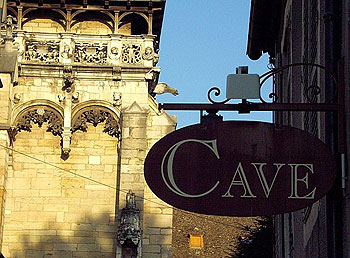
However, ‘life is what happens
while planning other things’ as they say ~ and one day I woke up in London
and realized that my long-held dream was looking unlikely to be fulfilled.
It suddenly came to me that not pursuing my dream was going to be far more
painful in the long run than simply throwing myself into action and going
for it! So after a period of research and several visits to Burgundy,
I set a date for departure.
My first step was to actually
get to France, which I did by crossing the English Channel in my Dutch
ex-sailing barge. With the help of friends, I navigated for
three long weeks through the waterway network going through, what seemed
at the time, hundreds of locks to get to St Jean de Losne in Burgundy where
there was a mooring awaiting me. In France there are not that many
suitable employment opportunities for foreigners, so I knew I had to get
straight in there and get my business up and running.
I
was
confident that I had the skills necessary to offer a truly special experience
for my clients, and my nine years working for Eurotunnel had honed my business
and language skills, both essential in my future undertakings.
Now, I’m delighted to say
that my company Burgundy
on a Plate offers a taste of the real Burgundy, as it’s experienced
by the people who live here. The pride in its cuisine, the magnificence
of its vines and wines and the quality and variety of its produce makes
Burgundy a perfect region for a wine and gastronomy discovery tour.
These private, guided tours
will bring participants a deeper knowledge and understanding of the history,
wine, and gastronomy of this region, enabling them to meet wine producers
in family-owned vineyards, to taste artisanal local specialities in some
remote locations, and to dine in some unusual restaurants, such as a ferme
auberge run by local farmers' wives or a restaurant in a wine cellar.
In addition to our week-long
tours, there are eight one-day themed tours to choose from ~from wine and
cheese to Cassis, Cooking, and Côte de Nuits ~ for those people with
limited time in the area. We also offer custom-made tours,
and whether one's interests lie in wine, gastronomy, history, art, architecture,
golf or cooking, we can design and create a tour especially for those interests.
At last I am doing something
in my life that I love, and I hope that some of this love of Burgundy
rubs off on my clients. Judging by their reactions ~ it’s working!
Home
| Newsletter | Style
de Vie | Carte Postale | Marketplace
| Galerie | Archives
| Links | Contact
Us | Search
©1998-2008
Cold Spring Press All Rights Reserved
|